What are forward, futures, and option transactions?
Among derivative financial instruments, the most common are forward, futures, and option transactions. They are used in exchange trading and in relationships between several companies. Despite the fact that options, futures, and forwards are very similar to each other, they have several fundamental differences that determine their use in a particular field.
What are option transactions?
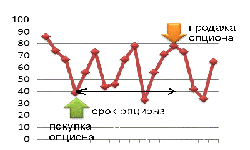 An option is one of the first derivative financial instruments (an agreement, contract, the main object of which is an underlying asset) to appear on stock exchanges.
An option transaction is an agreement between two parties, one of which receives the right, but not the obligation, to buy or sell an asset. The asset price (strike price) is agreed in advance and remains unchanged throughout the entire term of the security. The option expiration period, that is, the period for which it is concluded, may last several months, but the holder of the contract has the right to demand early expiration. Expiration means the fulfillment of the conditions stipulated in the option.
Option transactions are mainly concluded in order to make a profit from fluctuations in the value of the asset. The seller of the security assumes a high risk: before the expiration date, the option price may change in an unfavorable direction for them. In such a case, they will have to pay the difference between the market and strike prices at their own expense. In exchange for the risk, the seller receives a one-time payment — the option premium. It is equivalent to the probability of an unfavorable outcome. The buyer does not bear such risks. If the price changes not in their favor, they can simply refrain from exercising the contract.
Types of option transactions
Forward, futures, and option transactions are divided into several types. In the case of options, these are call and put. Such classification is explained by what specific right is granted to the buyer: to sell or to buy an asset.
Call options
This type of security gives its holder the right, but not the obligation, to purchase an asset in the future at a price agreed upon at the present moment. They are also called buyer’s options.
A call option is a favorite trading instrument on stock exchanges for the purpose of making quick profits. If the expiration period, strike price, premium, and the asset itself are chosen correctly, one can earn well from market fluctuations.
For example, a trader acquires a currency option to buy dollars at the current exchange rate (38 rubles) for a period of one month. Having assessed the possible risk, the seller sets a premium of 6% of the total amount of the purchased currency. Soon the dollar exchange rate rises by 8.2% and becomes 41.1 rubles. By exercising the option, the trader can make a profit of 3.2% (8.2% growth minus 6% premium) of the invested amount. The trader buys the required amount of currency from the option seller and immediately sells it at the current market price. For every thousand, they receive 32 dollars in net profit. Of course, much larger sums circulate in serious option transactions, which is why the amount of profit becomes colossal.
Put options
 Such an option allows selling an asset at an agreed price. The seller is obliged either to purchase this asset or to compensate the difference between the strike and market prices.
Put options are acquired to make a profit from changes in the value of the asset, but more often they are used for hedging — that is, concluding one type of transaction to insure investments in others.
For example, a trader buys a block of shares of a well-known company at an average price, but soon learns that they may fall sharply in value. They decide to hedge using a put option. By acquiring such a security, the trader gets the opportunity to sell the assets at the price at which they themselves purchased them. Thus, they reduce possible losses to the level of the option premium, and if the share price really falls, they do not have to worry about serious losses.
What is a futures transaction?
Futures are quite often confused with options, since they differ by only one detail. Unlike options, a futures agreement imposes obligations on both parties to the contract. A futures contract is an agreement for the delivery of an asset in a subsequent period of time, in which the asset price is agreed in advance.
The execution and fulfillment of futures contracts are controlled by the stock exchange. It certifies the transaction and checks the correctness of all documents, such as the specification. This term refers to an appendix to the main contract, which specifies more detailed characteristics of the asset. The exchange has the right to declare the transaction invalid if the following items are not fully specified in the specification:
- Contract number and subject.
- Type of contract.
- Circulation periods.
- Delivery dates.
- Full description of the goods (marking, quality, quantity, type of packaging).
In the futures contract itself, only two of the most important points are described — the asset and its strike price.  Since both parties to the contract are in an equal position, the concepts of “seller” and “buyer” are no longer used. There is also no concept of a premium in the sense in which it is used in option sales. One of the parties only pays for the services of a broker (intermediary) who helped find a favorable offer on the exchange.
A futures transaction is a mutually beneficial agreement. It can be viewed from two sides at once. In one case, futures are used as a guarantee of a successful purchase and sale transaction regardless of the state of the asset on the market. On the other hand, a futures contract is a transaction as a result of which one of the parties will gain, and the other will lose a significant part of potential profit. At the moment of concluding the contract, one can only guess who will end up in which position.
Types of futures
As has already been said, futures can be used both for concluding a mutually beneficial transaction and for achieving personal gain. Depending on this, such documents can be divided into deliverable and cash-settled.
Deliverable futures
Such a contract is concluded when its main purpose is indeed the purchase and sale of an asset. As a rule, its initiator is the supplier, who does this to hedge funds invested in production.
The main industry engaged in issuing futures is agriculture, the production of fermented milk products, alcoholic beverages, and so on. Such popularity is explained by the specifics of this type of production: funds invested in goods are recouped only after their maturation (readiness) and sale, which takes from one to several seasons. During this time, the average price of the asset may fall. In order to obtain a guarantee of recouping their expenses, the producer gives up the profit they could receive if the price of the goods changes in their favor. The other party to the agreement wishes to purchase the goods they need, but hopes to do so at a more favorable price.
The second party to the agreement is usually companies that are engaged in further processing of the products of the aforementioned industries.
A successfully concluded deliverable transaction in most cases is the first step toward fruitful and mutually beneficial cooperation. Many partners subsequently conclude forward transactions. We will explain how such agreements (forward, futures) differ from options a little below.
Cash-settled futures
If both parties conclude a futures transaction solely for the chance of making a profit, the delivery of the asset itself makes no sense: after all, one participant can simply pay the other the amount they could have received in a favorable outcome.
The impetus for the emergence of this type of security was the sharp growth in the number of traders whose main goal is speculation.
Cash-settled futures can be called one of the varieties of betting transactions in the stock market, since in essence both parties to the agreement place bets, as a result of which they may either make a profit or incur financial losses.
What are forward transactions?
This type of derivative financial instrument will be discussed the least, since it has only one difference from a futures agreement — the absence of control by the stock exchange.
Forwards are convenient for both parties in that they do not have to pay for the services of intermediaries, which are usually quite expensive. The disadvantages of forward transactions include the fact that their conclusion and execution are not controlled by higher authorities, therefore one cannot be completely sure of the correctness of the entire procedure.
Nevertheless, this fact cannot be called an absolute disadvantage, since contracts are usually concluded by companies that have already worked with each other.
Types of forwards
Just like futures, forward agreements are divided into deliverable and cash-settled.
Deliverable forwards
 This type of contract is the most common. It is concluded between companies that have already entered into a futures agreement with each other or have other guarantees of mutually beneficial cooperation. Each of the parties gives up possible profit in exchange for uninterrupted delivery (sale) of the underlying asset.
Cash-settled forwards
A cash-settled forward transaction does not imply the transfer of the asset from one party to another at the moment the document expires. Since the issuance and sale of such contracts are not controlled by global stock exchanges, the implementation of cash-settled forwards is carried out by amateur traders who do not have sufficient qualifications to work in the stock market. Bets on such documents are, of course, much lower than on futures, due to which even investors without large sums can afford such “play”.