What is an option strike price?
When concluding an option transaction, not only the underlying asset is of great importance, but also the option strike price. In some types of securities, this parameter is almost the most important one.
What is an option strike price?
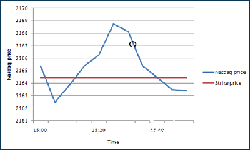 The strike is the price that is agreed upon in advance in the document and remains unchanged throughout the entire period of its validity, regardless of the position of the asset on the market.
The option buyer receives the right to buy (call option) or sell (put option) the asset at the strike price, and the seller, in turn, undertakes to fulfill this right.
The strike price should not be confused with the option price, or, as it is more often called, the premium.
The premium is the amount paid by the buyer to the seller in exchange for the obtained right. The main source of income for sellers is precisely the premium. If the option right is not exercised by the buyer, the premium remains in full with the seller. The option strike relates to the underlying asset — the main object of the option transaction.
How is the strike price set?
1) The average price over a period is calculated.
In most cases, the strike is equal to the current average market price of the asset. To calculate it, a certain time period is taken, most often one month. Prices for each individual day are added together, and then the sum is divided by the number of days in the period.
For example, let us take a currency option to buy dollars. The date of drawing up the document is November 25, 2014. To calculate the average price, the exchange rate for the past week is used. According to reliable sources, the following data are known: on November 18 the dollar rate was 47.3 rubles, on November 19 — 47 rubles, on November 20 — 47 rubles, on November 21 — 46.7 rubles, on November 22 — 45.8 rubles, on November 23 — 45.8 rubles, on November 24 — 45.8 rubles, on November 25 — 44.8 rubles. Based on this, the average exchange rate for the week can be calculated. It will be equal to (47.3 + 47 + 47 + 46.7 + 45.8 + 45.8 + 45.8 + 44.8) / 7 days = 46 rubles. This figure will be the strike price of the currency contract used in the example.
2) The market price valid at the moment the document is concluded is set.
 A price set in this way is very risky for the seller of the security, since literally the next day it may sharply rise or, on the contrary, fall not in their favor. Such risk is balanced by a more substantial premium.
For example, the price of the underlying asset — shares of a well-known company — at the moment of concluding a call deal is 125 rubles, but recently this indicator has fluctuated strongly in the range from 100 to 150 rubles. The maximum possible growth is 50%, which is very risky for the seller, so they set a high premium level. Usually it is from 5 to 10% of the investment amount, but this time the seller asks for 22%, that is, if one wishes to buy 1,000 shares at 125 rubles, the buyer must pay 27,500 rubles for the option. If they do not exercise their right, this entire amount remains with the seller.
Suppose the buyer agreed to such a deal and nevertheless exercised their right before its expiration, since the share price rose by 30% and is now equal to 162.5 rubles. The buyer’s profit will amount to a 30% increase minus the 22% option premium = 8% of the investment, and for the seller this amount will be a loss. If the seller had agreed to standard option sale conditions and charged a premium of 10%, the losses would already amount to 20% of the strike price multiplied by the quantity of the asset.
3) It is set regardless of the market price.
 In ordinary options, such a strategy is, of course, not used. For a transaction to take place, both parties must be satisfied with both the strike and the option price. They must agree with each other on the values of both parameters, and for this it is best to use calculations based on the market price.
In some types of exotic options, additional execution conditions are added that increase the possibility of financial losses for the holder. To balance the risk, the seller offers the buyer a more favorable strike price, which may differ significantly from the market value.
Such price calculation is most often used in barrier and range options. The condition for executing a barrier transaction is that the market price of the asset reaches a certain level, the barrier. At the moment of expiration of a range option, it is necessary that the market price be within a certain interval, for example, greater than or equal to N, but not greater than N+5.
For example, at the moment the dollar exchange rate is 40 rubles. A barrier call option is concluded, in which the buyer is given the right to buy dollars at 36 rubles, but it can be exercised only if by the time of execution the rate reaches 42 rubles. Or the parties conclude a range call option, and for its execution the dollar rate must be in the range from 42 to 43 rubles.
In both cases, the buyer can obtain colossal profit, but the risk of complete loss also increases significantly.
What depends on the strike price?
 In the examples of strike price calculation, it was mentioned that the option premium depends on it. The less the exercise price corresponds to the real market situation, the more expensive the option is. An exception is exotic options, in which an unrealistic price is balanced by additional transaction conditions.
The buyer’s profit depends on the relationship between the market and strike prices. In the case of a call option, the market price must be higher than the strike; in a put option, on the contrary, lower.
Thus, this parameter is equally important for both the buyer and the seller.
Strike price of binary options
Binary options can also be classified as exotic. Here, the concept of strike means the same as in the case of ordinary securities. In binary options, the exercise price is always equal to the exact value at the moment the transaction is concluded. The trader’s profit depends on whether the market value rises or falls relative to the strike.
The entire outcome may depend on the correct choice of the moment of the “bet.” After all, for example, at a certain moment the price may fall by several points and then immediately rise back to its usual level. If one catches the moment of decline, a good income can be obtained.